What Actually Beats ATS in 2026 (Not a Resume Builder)
Introduction
Picture this: you spend an evening feeding your story into a shiny resume builder, hit download on an "ATS-optimized" file, upload it to a job portal, answer a few questions, then wait. Days pass. No call. No email. Just silence that makes you wonder if a robot tossed your resume in the trash.
What actually beats ATS in 2026 is a targeted, outcome-driven story aligned across your resume, LinkedIn, and outreach — not a resume builder template. You keep hearing that hiring software "kills" 75 percent of resumes before a person even looks. Many tools repeat that claim to sell more templates and upgrades. The truth behind What Actually Beats ATS in 2026? (It's Not a Resume Builder) is far less dramatic and far more under your control.
In this article, we break down how an applicant tracking system (ATS) really works, what actually helps you stand out in 2026, and why your resume is probably seen more than you think. You will also see how our team at ShviiAI uses one connected dashboard to cover your resume, LinkedIn, outreach, and interview prep without trapping you in subscriptions. Stay to the end and you will leave with a simple, realistic plan to get more callbacks—not just another template to download.
Key Takeaways
ATS works as a filing tool. It stores and sorts your data; it is not a robot judge.
Most auto-rejection comes from knockout questions. These live in the application form, not in your margins or font size.
Modern hiring software reads meaning. It rewards clear stories with real impact, not messy keyword stuffing.
The real contest is human attention. Beating ATS in 2026 means helping a busy recruiter see your fit fast.
You need one clear story across channels. Align your resume, LinkedIn, and outreach instead of polishing a single shiny document.
ShviiAI brings seven career tools into one dashboard so your entire plan lives in one place.
The ATS Myth That's Been Costing You Sleep (And Job Offers)
The most costly ATS myth in 2026 is the belief that automated software — not a human — makes the final call on your application. That belief pushes people toward "secret" templates, strange hacks, and expensive resume builders that promise far more than they deliver. We talk to job seekers every week who are losing sleep over a system that is far simpler than advertised.
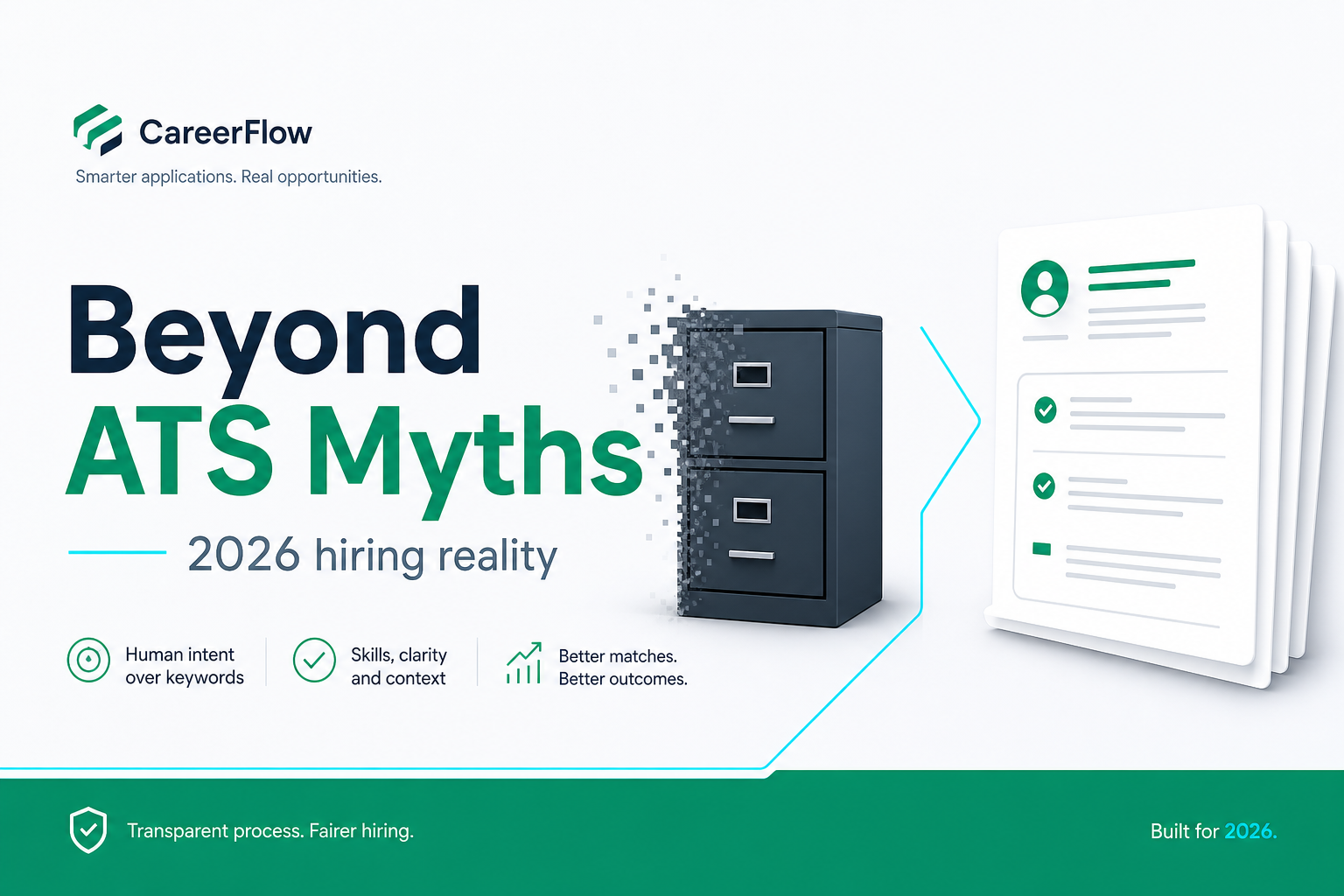
Here is the first thing worth remembering about what actually beats ATS in 2026. An applicant tracking system is closer to a giant, searchable filing cabinet than a hiring robot. Platforms like Workday, Greenhouse, Lever, and iCIMS — which together power recruiting at thousands of companies — all work on the same basic principle: recruiters open a job in their ATS, see a list of applicants, and click through resumes themselves. When someone marks you as rejected, the software sends the email—but a human made that call.
Let's walk through three ATS myths that cause the most stress and wasted money.
Myth 1: "AI rejects most resumes before humans see them." What really happens is far less dramatic. The system parses your resume into fields so the recruiter can scan faster. If you meet the basic rules from the application form, your name lands in that list and a person still decides what happens next.
Myth 2: "There is one perfect ATS-friendly template." In real life, there are hundreds of ATS tools and each company sets them up differently. A layout that parses nicely in one system can look slightly off in another. Simple, clean formatting travels well, but no single file type or layout beats every ATS in 2026.
Myth 3: "Your resume gets one secret ATS score." Some tools let recruiters search by keywords, but there is no universal pass‑or‑fail number. Modern systems use natural language processing (NLP) and AI screening technology to search for context and meaning, not just how many times you wrote "project management." Chasing a fake score pulls your attention away from the real goal: showing clear value to the hiring manager.
Once these myths fall away, you can stop fighting a ghost. That frees up energy to focus on content, story, and strategy—which is what actually beats ATS in 2026.
"ATS is a filing cabinet, not a hiring manager. The first real filter is a human eye."
— Common saying among experienced recruiters
What Actually Gets You Auto-Rejected (It's Not Your Margins)
Auto-rejection in ATS systems is triggered by knockout questions on the application form — not by your resume formatting, margins, or font choices. These yes‑or‑no questions appear right before you upload your resume, and they check hard requirements that a hiring manager or HR team has marked as non-negotiable. The ATS follows those rules without emotion.
These questions do not measure your potential or how well your resume reads. They simply check basic facts a company views as non‑negotiable. That is where auto‑rejection really happens—and it has nothing to do with your font, margins, or how you phrased an achievement.
Here are common knockout areas that can stop your application before anyone reads a single bullet point:
Work authorization often comes first. If a role requires the right to work in the United States without sponsorship and you say no, the system moves you out of the process. No recruiter hates your resume in that moment—you simply do not meet a legal or policy requirement.
Visa sponsorship questions usually sit right beside that. When a company cannot sponsor visas for a job, they set a rule in the form. If you will need sponsorship now or later and they have marked that as a blocker, the system closes that door by design.
Location questions are another common filter. Many jobs need people in a set city or time zone. If you say you are not there and not open to moving, the ATS follows the rule that the recruiter or hiring manager created and stops your application.
Mandatory certifications show up in fields like accounting, project management, or healthcare. When a posting says a license is required and you answer that you do not have it, the system has no room to bend. It simply applies the rule.
Salary, travel, and start date questions also matter. If you ask far above the posted range, cannot travel when the role needs it, or cannot start anywhere close to the target date, the auto‑reject often fires based on those answers.
If you already know you do not meet one of these hard requirements, you often have two better options than guessing on the form:
focus your search on roles where you do meet the basics, or
reach out to a recruiter or hiring manager first to ask whether an exception is possible.
If you clear these gates, your resume almost always lands in front of a human. So the real question is not "Did ATS kill my resume?" The better question is, "Did I explain my value clearly enough for a fast human scan?" That focus is what actually beats ATS in 2026.
What Beating ATS Actually Looks Like in 2026
Once you accept that your resume probably does reach a person, the game changes. Beating ATS in 2026 stops being about secret formatting tricks and starts being about how fast a recruiter can see your fit. The system is just the road; your story is the vehicle.
First comes semantic storytelling. Modern hiring tools — including AI screening engines built on natural language processing (NLP) — do more than match exact words; they connect related terms and look at how skills link to outcomes. According to the U.S. Department of Labor's research on automation in hiring, AI-assisted screening is now standard practice at large employers. Instead of a flat line that reads "Managed software rollout projects," a stronger line reads:
"Led a cross‑functional team of five to deliver a software integration two weeks early, raising process speed by fifteen percent."
The skill and the result sit together, which helps both the software and the human see why you matter.
"Your resume is not a list of tasks; it is a highlight reel of outcomes."
— Common mantra among career coaches and hiring managers
Next comes targeted adjustment for each posting. We know it is tiring to hear, but generic resumes lose. When we help people at ShviiAI, we start by scanning the job ad for repeated skills and themes, then work those terms into the summary, bullets, and skills section in natural language. That does not mean copying every word; it means choosing the right parts of your story that match what this role needs and putting them near the top — because a new study shows that fewer than 8% of resumes are truly "ATS-proof," and clean structure with tailored content matters far more than over-optimized formatting. Research from the Society for Human Resource Management (SHRM) also confirms that recruiters spend an average of just six to seven seconds on an initial resume scan, making clarity and relevance critical.
Formatting still plays a part, just not the part most builders talk about. A clean one‑ or two‑column layout, common fonts like Calibri or Arial, and standard headings such as Work Experience, Education, and Skills are more than enough. Avoid heavy tables, graphics, and fancy icons that can scramble parsing or distract the eye. The resume that beats ATS in 2026 is the one a recruiter can read on a laptop or phone without squinting.
Then there is the bigger picture. Recruiters rarely stop at your resume; they open LinkedIn, skim your activity, and check for a story that matches what they just read. That is why beating ATS in 2026 is really about one consistent narrative across every touchpoint. With ShviiAI, we built the resume builder, LinkedIn Optimizer, Job Tracker, Interview Prep, Cold DM Architect, Performance Review helper, and Salary Calculator into a single dashboard. That way, the same story flows from resume to profile to outreach message without you juggling five logins.
When all of this lines up, you are not trying to outsmart software. You are helping the right human find you faster and say yes with confidence.
How ShviiAI Helps You Win Beyond the Resume
ShviiAI is an all-in-one career dashboard built to close the gap between a polished resume and an actual job offer. While ATS platforms like Workday, Greenhouse, and Lever are the roads your application travels, ShviiAI ensures your story is strong enough to win once a recruiter or hiring manager opens your file. A resume alone only gets you to the starting line — what actually beats ATS in 2026 is everything that happens around it.
Here is how we support that wider plan, step by step:
The ATS‑optimized resume tool inside ShviiAI builds targeted versions fast. You pick a job, feed in your history, and our AI suggests clear, impact‑driven bullets that match the posting without sounding fake. The result is a clean file that parses well and reads well in the same moment.
Our LinkedIn Optimizer keeps your public profile in sync. It guides your headline, About section, and experience bullets so they echo the same story from your resume. Recruiters see one clear picture instead of mixed messages when they search your name.
Job Tracker keeps your whole search under control. You log roles, versions of your resume, and outcomes in one simple board. Over time, patterns appear, which helps you aim your effort toward the kinds of roles that respond best to you.
Interview Prep steps in when your strategy works and you start getting calls. It helps you turn bullets into stories, prepare strong answers, and connect your past work to what this hiring manager cares about. That way, you do not beat ATS and then freeze on the call.
Cold DM Architect supports another path that often beats ATS altogether. It helps you write direct messages to hiring managers or recruiters, grounded in the role and your value, so you can start real conversations outside the normal Apply button.
All of this runs on a pay‑per‑use credit model. There is no monthly subscription, no clock ticking on your access, and credits never expire. You get one dashboard for the full search instead of a stack of tools you forget to cancel.
Conclusion
ATS is not the villain it is sold as. It does not sit there judging your font or tossing out three‑quarters of resumes on its own. For most people who meet the basic rules in the form, a human still reads what they send. The real challenge is standing out in that short, fast human scan.
What actually beats ATS in 2026 is a sharp, clear story that runs through your resume, your LinkedIn, and your outreach. Clean formatting helps, but it is the way you connect skills to real outcomes—and line that up with each role—that wins attention. There is no magic template that can replace that work. As Google's re:Work hiring research confirms, structured, outcome-focused communication consistently outperforms keyword-heavy documents in capturing decision-maker attention.
ShviiAI exists to make that work lighter and more consistent. Instead of rewriting the same resume from scratch for every posting and guessing what to tweak, you can use one AI‑powered dashboard to handle the resume, the profile, the tracking, the outreach, and the prep. Let ShviiAI take on the heavy lifting so you can spend your time where it matters most: speaking with hiring managers and turning interviews into offers.
FAQs
Does ATS Really Reject Resumes Automatically?
Yes, but not the way the myths describe. Auto‑rejection almost always comes from knockout questions in the application form, such as work authorization, location, or required licenses. If you meet those basic rules, your resume nearly always lands in front of a human—and the quality of your content becomes the deciding factor.
What File Format Should I Use To Submit My Resume In 2026?
If the posting does not name a file type, a PDF is a safe default because it keeps your layout stable across devices. When an employer asks for a Word file, send that format instead. Modern ATS tools handle both PDFs and Word documents well when the content is clear and well‑structured.
Is Keyword Stuffing Still Effective For Beating ATS?
No. Older advice said to cram in every keyword from the job ad, even in hidden text. Modern systems and recruiter search tools focus on meaning and context. They respond better when you weave important terms into natural bullet points that tie your skills to clear, measurable results.
Do I Need A Different Tool For LinkedIn Optimization And Resume Building?
Using separate tools often creates small gaps between your resume and your public profile. Those gaps can confuse recruiters who check both. ShviiAI keeps resume creation, LinkedIn optimization, tracking, outreach, and prep in one place with a simple credit model, so your story stays consistent without another monthly subscription.
Keep going
Useful next steps from this article — tools to apply the advice, plus related career guides.
Tools
Related career guides
Account Executive Career Guide
Quota, attainment, and deal size. The sales resume is its own genre with its own rules.
Business Analyst Career Guide
The bridge role between business and engineering, and the bridge into both from elsewhere.
Customer Success Manager Career Guide
How to show impact when you do not carry a quota. The hardest resume problem in go to market.