Your Resume Gets 6 Seconds. Here's How to Make Them Count.
The Gut-Punch Truth
You spend hours on your resume. You tweak every verb, agonize over bullet points, and probably change the font three times. You hit “send” and then… crickets.
Or, if you’re lucky, a polite rejection email that feels like it was written by a robot who’s just as tired as you are. The job search feels like shouting into a void.
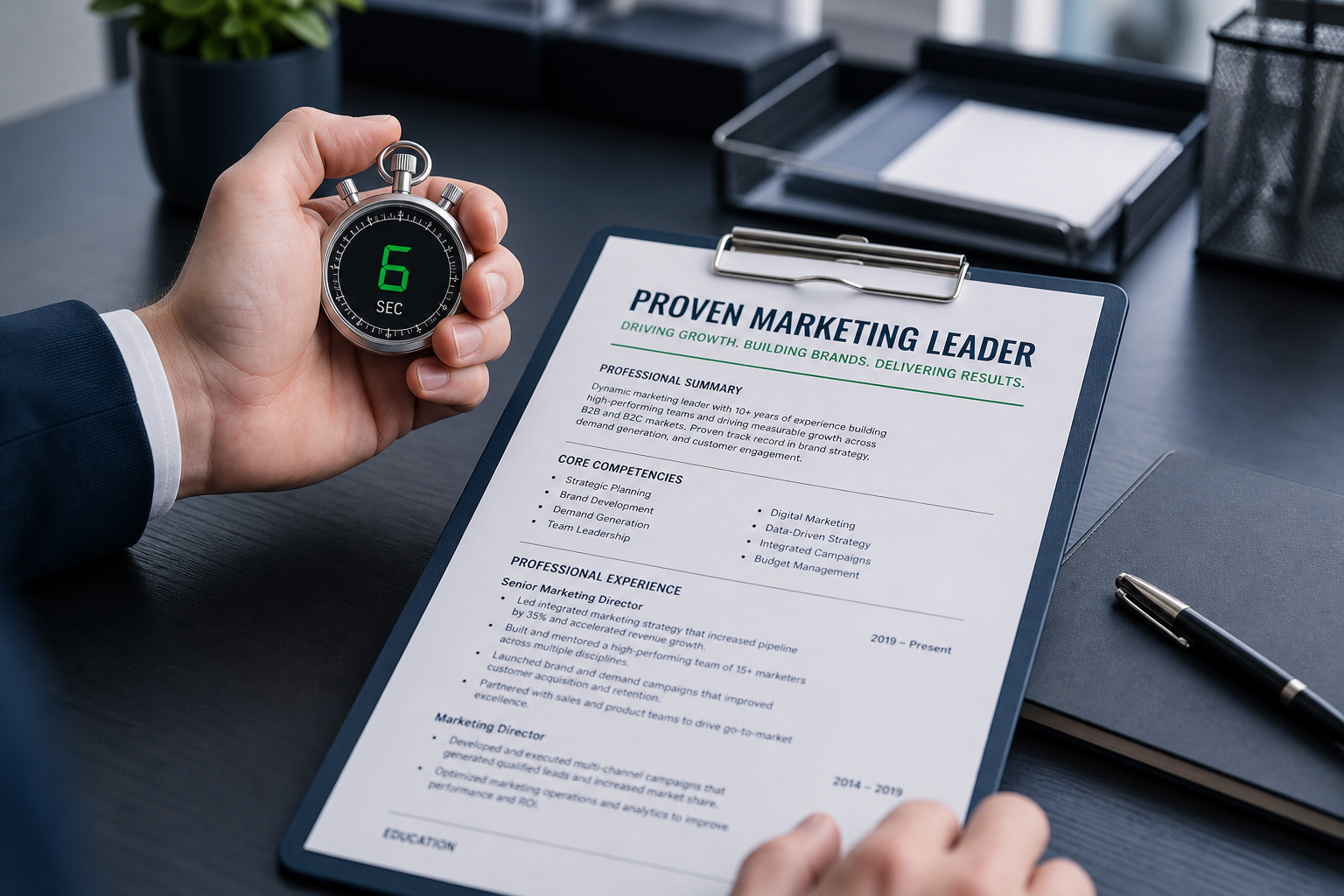
Here’s the gut-punch truth: they do read your resume. But not for long. Recruiters spend an average of six seconds – yes, six – scanning your resume before deciding if it’s worth a second look.
Six seconds to summarize your entire career, your aspirations, your very worth. It’s brutal, unfair, and completely unavoidable.
The Packaging Problem
Think about it from their side. They’ve got a mountain of applications. Each one looks suspiciously similar to the last. “Results-driven professional seeking challenging opportunity.” “Proven track record of success.” It’s a sea of corporate clichés, and they’re drowning in it.
Your resume isn’t being ignored because you’re not qualified. It’s being ignored because it’s not scannable. It’s blending in when it needs to pop. It’s a wall of text when it needs to be a billboard.
The real problem isn’t your experience — it’s the packaging. You’re trying to tell a novel when they only have time for a tweet.
The Marketing Brochure Approach
Here’s the insight nobody talks about: your resume isn’t a historical document. It’s a marketing brochure. Its sole purpose is to get you an interview. That’s it.
This means you have to flip your perspective. Stop thinking about what you did and start thinking about what the employer needs. Every single line should scream, “I solve your problems!” not “Here’s everything I’ve ever done.”
The counterintuitive truth is that less can be more. A resume that’s too dense, too wordy, or too generic is a resume that gets tossed. A resume that’s clean, focused, and tailored to the job description is a resume that gets noticed.
How to Make Those Six Seconds Count
- Ditch the generic objective statement. It’s dead. Replace it with a powerful, concise summary (2–3 lines, max) that highlights your most relevant skills and achievements for this specific job. Think of it as your resume’s headline — your David Ogilvy moment.
- Make your achievements quantifiable. Don’t just say “Managed projects.” Say “Managed 12 projects concurrently, reducing delivery time by 15% and saving 0k annually.” Numbers cut through the noise. They’re the clearest signal you can send in six seconds.
- Tailor, tailor, tailor. Read the job description carefully. What keywords do they use? What skills do they prioritize? Weave those into your resume naturally. If they want a “proactive problem-solver,” make sure your resume shows you being one.
- Make it easy on the eyes. Use clear headings. Ample white space. A readable font. No tiny margins. Recruiters are skimming, not studying. A clean layout guides their eyes to the good stuff. Tools like Shvii AI exist precisely to take the guesswork out of presenting your information cleanly.
Be Ruthless
Remember the six-second rule applies to your entire document. If a section doesn’t immediately grab attention or directly support your candidacy for this role, question its existence.
Be ruthless in your editing. Every word must earn its place. The job search is a marathon, but getting past the resume screen is a sprint.
One clear takeaway: Your resume’s job isn’t to get you hired; it’s to get you an interview. Treat it like a sales pitch, not a memoir.
Ready to build a resume that gets noticed?
Try Shvii AI TodayKeep going
Useful next steps from this article — tools to apply the advice, plus related career guides.
Tools
Related career guides
Account Executive Career Guide
Quota, attainment, and deal size. The sales resume is its own genre with its own rules.
Business Analyst Career Guide
The bridge role between business and engineering, and the bridge into both from elsewhere.
Customer Success Manager Career Guide
How to show impact when you do not carry a quota. The hardest resume problem in go to market.