






AI Resume Builders: What They Fix and What They Cannot
What these tools are actually good at
There is a real argument for using AI on your resume, and it is narrower than the marketing suggests.
Language models are genuinely good at a specific set of tasks. Turning a rambling description into a tight sentence. Making tense and formatting consistent across a document written over several years. Noticing that you described one role in detail and another in three words. Suggesting the standard vocabulary of a field you are moving into.
These are real problems and most resumes have several of them. If you have a document full of half-finished sentences and inconsistent dates, a model will improve it in about four minutes.
What it cannot do is know what you did.
The failure mode nearly everyone hits
The common approach is to paste in a job description and ask for a resume, or paste a thin resume and ask the model to improve it.
Both produce fluent, confident, entirely generic output. The model has nothing specific to work with, so it writes the average of every resume it has seen. You get "spearheaded cross-functional initiatives to drive operational efficiency", which sounds like achievement and contains no information.
Worse, thousands of other applicants are doing the same thing with the same tools. The resulting documents converge. Recruiters describe reading batches of applications that sound like one person wrote all of them, and the shared vocabulary has become recognisable enough that it now works against candidates rather than for them.
The specificity that makes a resume persuasive is exactly the thing a model cannot invent.
The genuinely dangerous part
Ask a model to make your resume more impressive and it will frequently add numbers.
It has no way of knowing whether you improved efficiency by 30%, so it picks a plausible figure. The sentence reads well. It is also a claim you cannot defend, and the first competent interviewer will ask how it was measured.
This is the single most common way AI-assisted resumes fail, and it fails at the worst possible moment. A candidate who cannot explain their own number has a credibility problem that spreads to everything else on the page.
Read every figure in an AI-edited resume and delete any you cannot source. If you did not put the number there, do not keep it.
One clear takeaway: a model can improve how you say something, and should never decide what you say.
A method that works
Use the tool as an editor, not an author.
Start by writing the raw material yourself, badly if necessary. For each role, dump what you actually did in plain language, including the numbers you genuinely know and the detail you would give a colleague. Grammar does not matter at this stage.
Then ask the model to tighten it, keeping every fact and adding none. That instruction matters and it needs repeating, because the default behaviour is to embellish.
Then edit what comes back. Cut the adjectives it added. Replace any sentence that would fit another candidate. Restore the specific detail it smoothed away, because models reliably trade precision for polish and precision is what you need.
Finally read it aloud. If it does not sound like something you would say, keep editing.
Where AI helps most, by task
- Consistency. Tense, date formats, punctuation across a document written over years. Genuinely tedious, genuinely improved.
- Compression. Turning six lines into two without losing the substance.
- Vocabulary translation. Describing your work in the language of a field you are moving into. Useful for career changers who do not yet know the idiom.
- Gap spotting. Asking what questions the resume leaves unanswered is one of the most useful prompts available and almost nobody uses it.
- Cover letter drafting, from material you supply, then heavily cut.
Where it helps least: deciding what matters, choosing what to leave out, and anything requiring knowledge of your actual career.
Do employers mind?
Almost no employer objects to a resume having been edited with software. Spellcheck has been assistance for decades and nobody considers it cheating.
What they object to, in practice, is the outcome. Generic prose that says nothing. Claims that collapse under questioning. A cover letter that could have been sent to any company.
Interviews resolve this quickly. A candidate who wrote their own material can talk about it for twenty minutes. One whose application was generated cannot, and the gap becomes obvious in the first few follow-up questions.
So the honest position is not that using AI is risky. It is that using it to avoid thinking about your own experience is risky, because the thinking is what the interview tests.
What about the tools that claim to beat applicant tracking systems?
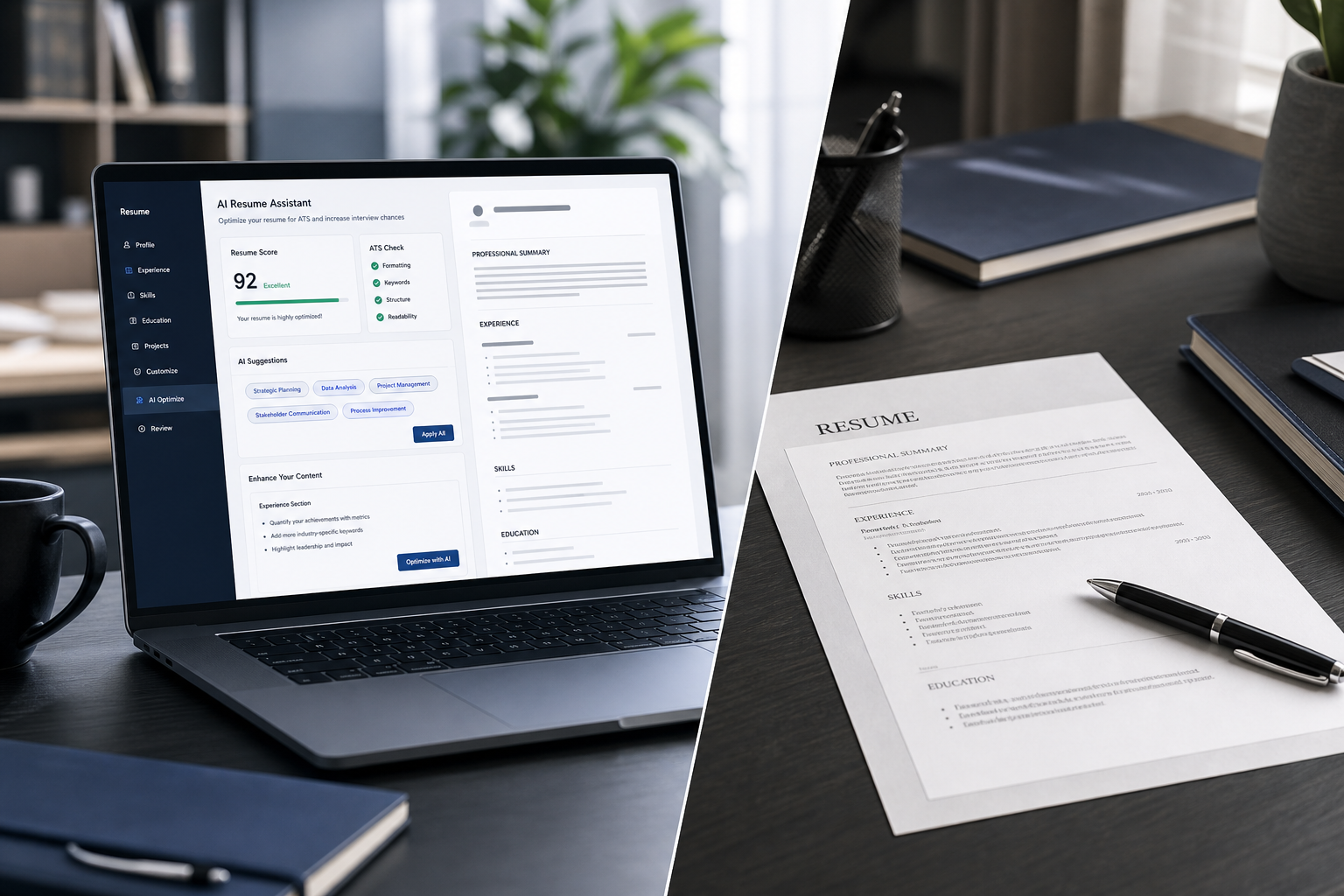
Many resume products lead with an ATS score, usually a percentage against a job description.
Treat those numbers as a rough completeness check rather than a verdict. Most applicant tracking systems do not score resumes at all; they parse and store them so recruiters can search. A vendor's score is their own model's opinion, not a reading from the employer's system.
The useful part is comparison. Showing which terms from the posting are absent from your document is genuinely helpful, because it catches the requirement you assumed was covered. Our free ATS scanner does exactly that and does not pretend the number means more than it does.
Our guide to how applicant tracking systems really work covers what the software actually does.
The interview is where an outsourced application unravels
The strongest argument for writing your own material has nothing to do with detection and everything to do with what happens next.
Preparing a resume forces you to remember your career in detail. Which project was hardest, what the numbers actually were, what you would do differently. That recall is precisely what an interview tests, and candidates who did the work arrive with it loaded.
A candidate who generated their application skipped that step. They then sit in an interview being asked about achievements they did not choose and cannot elaborate on, which is uncomfortable and visible.
So even treating it purely selfishly, the hour spent writing your own raw material is not overhead. It is interview preparation that happens to produce a document.
Where the same tools genuinely earn their place
Two uses are underrated and neither involves generating prose.
The first is interrogation. Paste your finished resume and ask what a hiring manager would be sceptical about, or which claims lack evidence. Models are considerably better at criticism than at composition, and the list you get back is usually accurate and uncomfortable.
The second is preparation. Give it the job description and ask what it would ask you in an interview. The questions are usually close enough to the real ones to be worth rehearsing, and it costs nothing.
Both use the model on material that already exists, which is where these tools are strongest and where the failure modes above do not apply.
Choosing a tool, if you are going to use one
Things worth checking before you commit.
Does it let you edit the output freely, or does it lock you into a template? A tool that fights your edits produces the version it wanted rather than the version you need.
Does it export a clean text-based file? A beautifully designed resume that exports as an image parses as nothing, which defeats the purpose entirely.
Does it add claims you did not make? Test with one role and read the output closely. If it invents numbers, that is disqualifying.
What does it do with your data? You are handing over your employment history and contact details.
Is the pricing a subscription for something you will use for six weeks? Job searches end, and a monthly bill that continues afterwards is a poor trade.
Questions people ask
Is it acceptable to write a resume with AI?
Yes, as an editor working on material you supply. Employers object to generic output and unverifiable claims, not to the use of software.
Can recruiters tell a resume was written by AI?
Frequently, because default output has a recognisable vocabulary and says little. Supplying your own specifics and cutting the added adjectives largely removes the tell.
Will an AI resume builder get me past the ATS?
Most tracking systems store and search rather than score, so there is nothing to get past. The useful function is checking which terms from a posting are missing.
What is the biggest risk of using AI on a resume?
Invented numbers. Models add plausible figures when asked to make a resume impressive, and those claims fail at the first interview question about how they were measured.
What is the best prompt for improving a resume?
Give it your raw description and ask it to tighten the writing while keeping every fact and adding none. Then ask what questions the resume leaves unanswered.
Related reading
- Job Boards: Which Ones to Use and How to Search Them Properly
- Questions to Ask an Interviewer That Are Worth Asking
Check what your resume is missing
Run a free scanKeep going
Useful next steps from this article - tools to apply the advice, plus related career guides.
Tools
Related career guides
Account Executive Career Guide
Quota, attainment, and deal size. The sales resume is its own genre with its own rules.
Business Analyst Career Guide
The bridge role between business and engineering, and the bridge into both from elsewhere.
Customer Success Manager Career Guide
How to show impact when you do not carry a quota. The hardest resume problem in go to market.