Avoid These Common Resume Mistakes for Success
Your resume must grab attention in a crowded job market. Common pitfalls can sink applications. This article pinpoints frequent resume mistakes and shows quick fixes. Apply these tactics to enhance your resume's impact and boost your job prospects.
Key Takeaways
- A strong resume summary highlights key qualifications and career goals.
- Quantifying achievements with specific metrics enhances your resume.
- Tailoring your resume with relevant keywords improves ATS compatibility.
- Consistent formatting and clear layout increase readability.
- Using action-oriented language effectively addresses employer needs.
- Proofreading for grammar and spelling errors is essential for professionalism.
- AI tools can optimize resumes by suggesting keywords and providing feedback.
- Keep your resume concise, ideally one page for less than 10 years of experience.
Essential Resume Writing Tips
Build an effective resume by mastering core components. Clearly communicate your skills, experience, and achievements. Tailor every section to the job you want.
Start with a Strong Summary
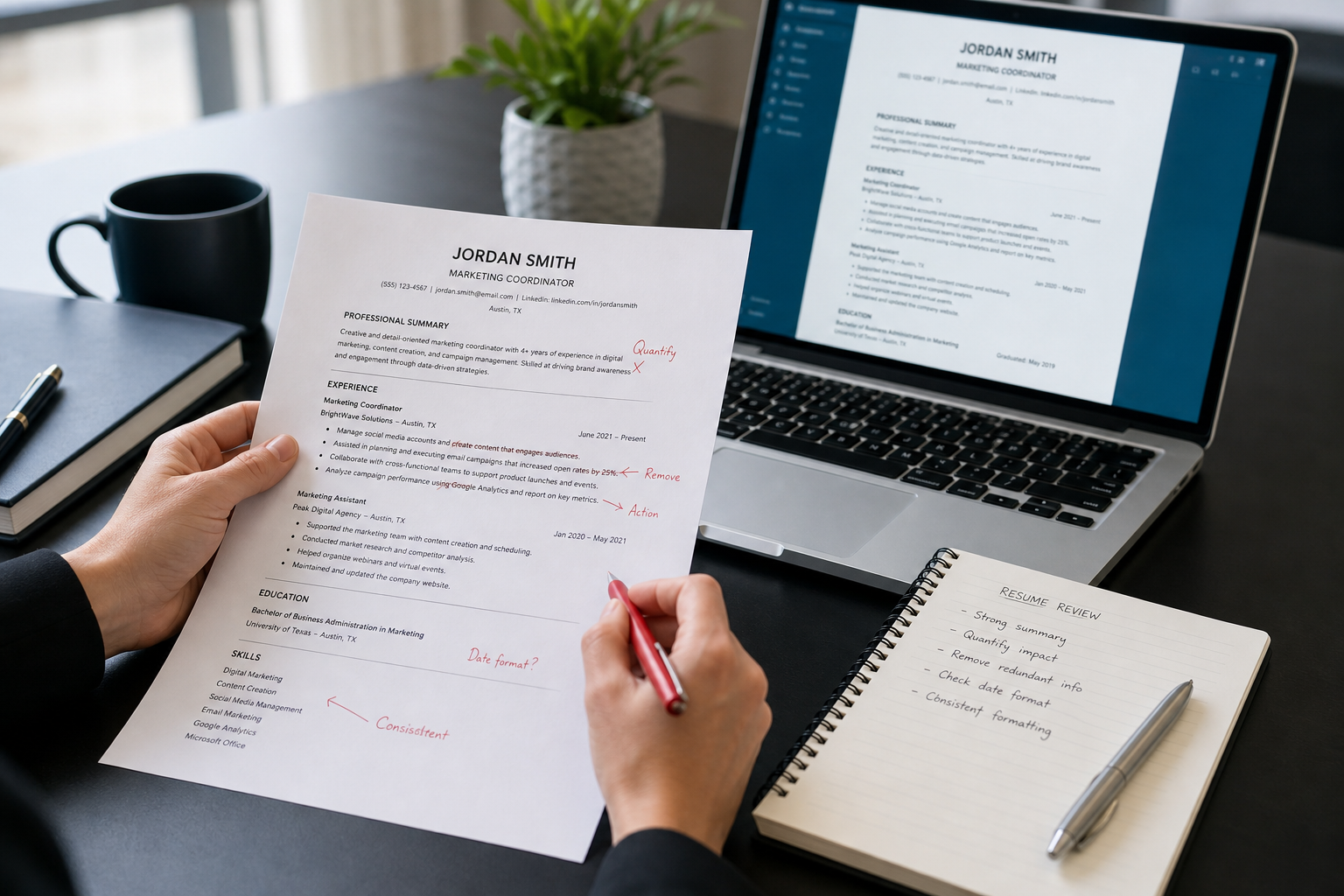
Your resume should begin with a concise summary highlighting your key qualifications and career goals. This section sets the tone for the rest of your resume.
Quantify Achievements
Use specific numbers to demonstrate accomplishments. For example, instead of saying "managed a team," say "led a team of 10 to achieve a 20% increase in sales." This adds weight to your claims.
Tailor Your Resume
Customize your resume for each job application by incorporating relevant keywords from the job description. This shows your suitability for the role and helps your resume pass through Applicant Tracking Systems (ATS).
Common Errors to Fix Quickly
Even experienced candidates make mistakes. Spotting and fixing these errors boosts your odds. Watch for the following:
- Generic Content: Avoid vague language. Tailor your content to reflect your unique qualifications.
- Overly Dense Text: Use bullet points and clear formatting. Dense blocks of text can overwhelm hiring managers.
- Ignoring Formatting: Consistent formatting is crucial. Use uniform fonts and sizes to enhance readability.
Effective Strategies for a Standout Resume
Want a standout resume? Use these strategies:
- Empathy in Writing: Understand the employer's needs and tailor your resume to show how your skills can meet those needs.
- Use Action-Oriented Language: Start bullet points with strong action verbs like "achieved," "developed," and "led" to convey your contributions effectively.
- Highlight Relevant Skills: Focus on skills related to the job you are applying for to align your qualifications with the employer's expectations.
How Does Poor Formatting Kill Your Job Chances?
Formatting shapes first impressions. Bad formatting can hide your strengths. Keep these points in check:
- Dense Text: Avoid dense paragraphs. Use bullet points and short sentences for clarity.
- Inconsistent Headings: Ensure your headings are consistent in style and size.
- Small Fonts and Margins: Use a readable font size and adequate white space.
Which Resume Formatting Guidelines Boost ATS Compatibility?
ATS scan resumes before a human sees them. To be ATS-friendly, follow these guidelines:
- Use Standard Headings: Stick to conventional headings like "Experience" and "Education." This helps the ATS categorize your information.
- Simple Layout: Avoid complex designs or graphics that may confuse the ATS.
- Readable Fonts: Choose fonts like Arial or Times New Roman for clarity.
Why Is ATS Optimization Critical?
Optimizing for ATS is essential. Many employers use these systems to filter candidates. Studies show many resumes get rejected by ATS before reaching a human.
ATS-Friendly Resume Tips
To avoid the 70% rejection rate, create an ATS-optimized resume. Use proper formatting and the right keywords to ensure your resume is recognized and considered.

How Can You Spot and Fix Grammar and Spelling Errors Quickly?
Typos and bad grammar can kill your credibility. Use these tactics:
- Read Aloud: This helps catch errors that you might overlook when reading silently.
- Use Tools: Grammar and spell-check tools can identify potential mistakes, but don't rely solely on them.
- Get a Second Opinion: Ask someone else to review your resume. A fresh set of eyes can catch errors you may have missed.
Which Resume Proofreading Checklist Ensures Error-Free Content?
Use a checklist to systematically hunt errors. Include:
- Spelling Checks: Verify all words are spelled correctly.
- Consistency in Formatting: Ensure font sizes and styles are uniform throughout your resume.
How Do AI Tools Help Score and Improve ATS Compatibility?
AI tools can enhance your resume and ATS compatibility. They analyze job descriptions and suggest relevant keywords to include, improving your chances of passing ATS filters.
How Do You Make Your Resume Content Relevant and Impactful?
Make your resume content relevant and impactful with these strategies:
- Concise Summary: Start with a brief summary that highlights your most relevant qualifications.
- Quantifiable Achievements: Use specific metrics to demonstrate your accomplishments.
What Are Quick Fixes to Avoid Common Job Application Errors?
Fix common application errors fast:
- Ditch the Generic Objective: Replace it with a tailored summary highlighting your qualifications.
- Make Achievements Quantifiable: Use specific metrics to demonstrate your contributions.
How Long Should Your Resume Be for Maximum Impact?
Resume length depends on experience:
- One-Page for Less Than 10 Years: Aim for a one-page resume.
- Two-Page for Extensive Careers: A two-page resume may be appropriate for extensive careers.
Ready to enhance your resume?
Try Shvii AI TodayFAQs
What are common mistakes on resumes?
Common mistakes include generic content, poor formatting, and spelling errors. Tailoring your resume and proofreading can help avoid these issues.
How can I improve my resume for ATS?
Use standard headings, a simple layout, and relevant keywords from the job description to improve ATS compatibility.
How important is proofreading my resume?
Proofreading is crucial. Spelling and grammar errors can significantly reduce your chances of getting an interview.
Keep going
Useful next steps from this article — tools to apply the advice, plus related career guides.
Tools
Related career guides
Customer Success Manager Career Guide
How to show impact when you do not carry a quota. The hardest resume problem in go to market.
Account Executive Career Guide
Quota, attainment, and deal size. The sales resume is its own genre with its own rules.
Business Analyst Career Guide
The bridge role between business and engineering, and the bridge into both from elsewhere.