Tips for Making Your Resume Stand Out to Employers

Introduction
Tips for tailoring your resume are no longer optional in a hiring market where most employers run applications through an Applicant Tracking System (ATS) before a human ever reads them. A generic document that lists every job you have ever held might feel thorough, but it rarely proves you are the right fit for this role. The resumes that stand out are focused: they mirror the language of the job description, lead with measurable wins, and read clearly on screen and on paper.
This guide walks through practical resume tailoring tips you can use on every application — from replacing outdated objective statements to choosing the right format, action verbs, and keywords. You will also see how AI-powered resume tools like ShviiAI can speed up customization without turning your resume into keyword soup. By the end, you will know what to highlight, what to cut, and how to make each submission feel intentional rather than copy-pasted.
Key Takeaways
- Tailor every application. Customizing your resume for each job increases visibility and aligns your skills with what that employer expects.
- Use industry keywords and metrics. Role-specific language plus quantifiable achievements improve both ATS compatibility and human readability.
- Keep formatting clean. Readable fonts, bold headings, bullet points, and white space help recruiters scan fast.
- Avoid keyword stuffing and dense blocks. Natural, professional tone beats overloaded paragraphs every time.
- Pair resume and cover letter. A tailored cover letter reinforces the same wins and shows you understand the role.
- Leverage AI thoughtfully. Tools that analyze job descriptions can suggest keywords, gaps, and stronger phrasing — then you edit for accuracy.
Effective Resume Tailoring Strategies
Strong tailoring is not about rewriting your entire career story from scratch. It is about choosing the experiences, skills, and proof points that matter most for the opening in front of you.
- Ditch generic objective statements. Replace them with a short professional summary that reflects your qualifications and mirrors the job description.
- Quantify achievements. “Increased sales by 30% in six months” lands harder than “Responsible for sales.”
- Match keywords from the posting. Pull repeated skills, tools, and responsibilities into your summary, skills section, and bullet points — where they are truthful.
One clear takeaway: Targeted customization beats length. A two-page resume that speaks directly to the role will outperform a four-page history every time.
Tailoring Resumes for Specific Audiences and Roles
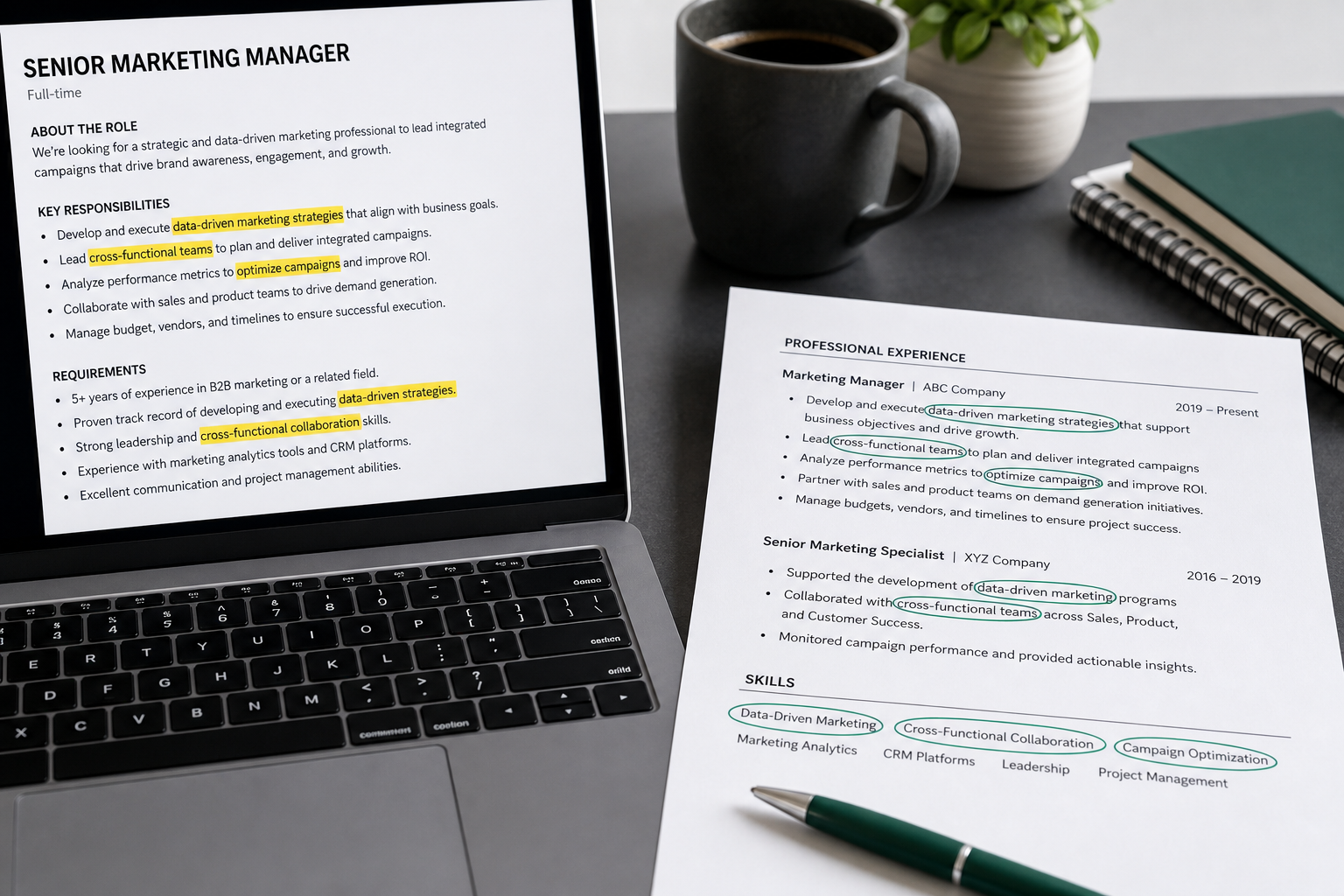
Different readers look for different signals. A hiring manager for a leadership role wants progression, scope, and team outcomes. A technical screener wants stack depth and project impact. A career changer needs transferable skills mapped clearly to the new field.
- Expand what is relevant; trim what is not. Move older or unrelated roles down or shorten them to one line.
- Emphasize leadership and delivery for management tracks — budgets, headcount, cross-functional wins.
- Translate your experience when switching industries so the connection is obvious in the first half of page one.
When you are ready to iterate quickly, ShviiAI’s resume builder helps you reshape bullets and keywords for each target role without starting from a blank page.
Key Elements to Highlight
- Problem-solving. Show moments where you diagnosed a challenge, chose an approach, and delivered a result.
- Measurable results. Percentages, revenue, time saved, error reduction, and team size all give context.
- Industry-specific keywords. Use terminology from the job post and your field so ATS filters and recruiters recognize fit.
Common Mistakes to Avoid
- One resume for every job. Mass applications with identical files miss the language each employer cares about.
- Keyword stuffing. Repeating terms unnaturally can hurt readability and raise red flags with experienced recruiters.
- Wall-of-text formatting. Long paragraphs bury your best lines; use bullets and subheadings instead.
- Vague wins. Swap “improved processes” for what changed, by how much, and for whom.
- Outdated objectives. Replace them with a tailored summary tied to the role you want now.
How AI-Powered Resume Tailoring Helps Your Job Search
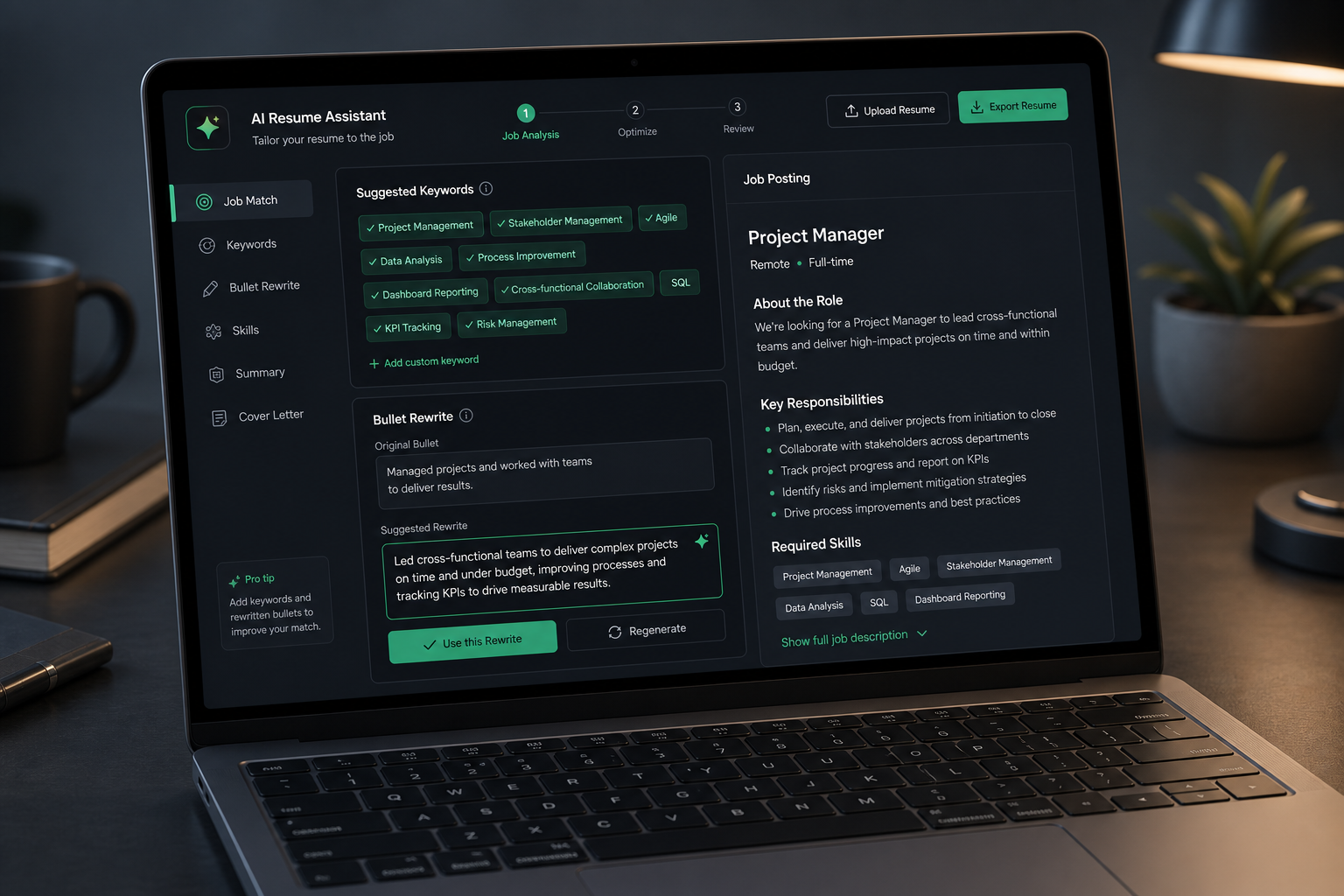
AI resume tools compare your document to a job listing, surface missing keywords, and suggest tighter phrasing. Used well, they save hours of manual scanning; used poorly, they produce generic text you still need to fact-check.
What AI Tools Actually Do
Modern builders analyze job descriptions for required skills, repeated phrases, and seniority cues. They can propose bullet rewrites, keyword lists, and formatting tweaks aimed at ATS compatibility. According to SHRM, most large employers rely on ATS software early in hiring — so semantic alignment matters as much as layout.
Matching Keywords to Employer Expectations
AI matching works best when you treat suggestions as drafts. Verify every line against your real experience, then keep language natural so both algorithms and humans can follow your story.
Keyword Optimization That Still Sounds Human
- Tailor each application with terms pulled from the posting — titles, tools, certifications, and outcomes.
- Focus on outcomes, not duties: what changed because you were in the role?
- Write in plain language. Clear sentences beat jargon stacks that confuse parsers and readers alike.
Action Verbs That Command Attention
Start bullets with verbs that show ownership: led, launched, accelerated, designed, negotiated, streamlined. Pair each verb with a metric or scope so the line feels complete.
- Led a cross-functional team of 8 to ship a product update two weeks ahead of schedule.
- Reduced customer churn by 12% in one quarter through a targeted retention workflow.
- Built a reporting dashboard that cut weekly reporting time from 6 hours to 45 minutes.
ATS Updates Worth Knowing in 2026
Filters are getting smarter about context, not just exact keyword matches. That means a coherent career narrative — consistent titles, clear progression, and skills tied to outcomes — often performs better than a list of buzzwords. Clean headings, standard section labels (Experience, Education, Skills), and export-friendly PDFs still matter for parsing accuracy.
Best Resume Formats for Employers
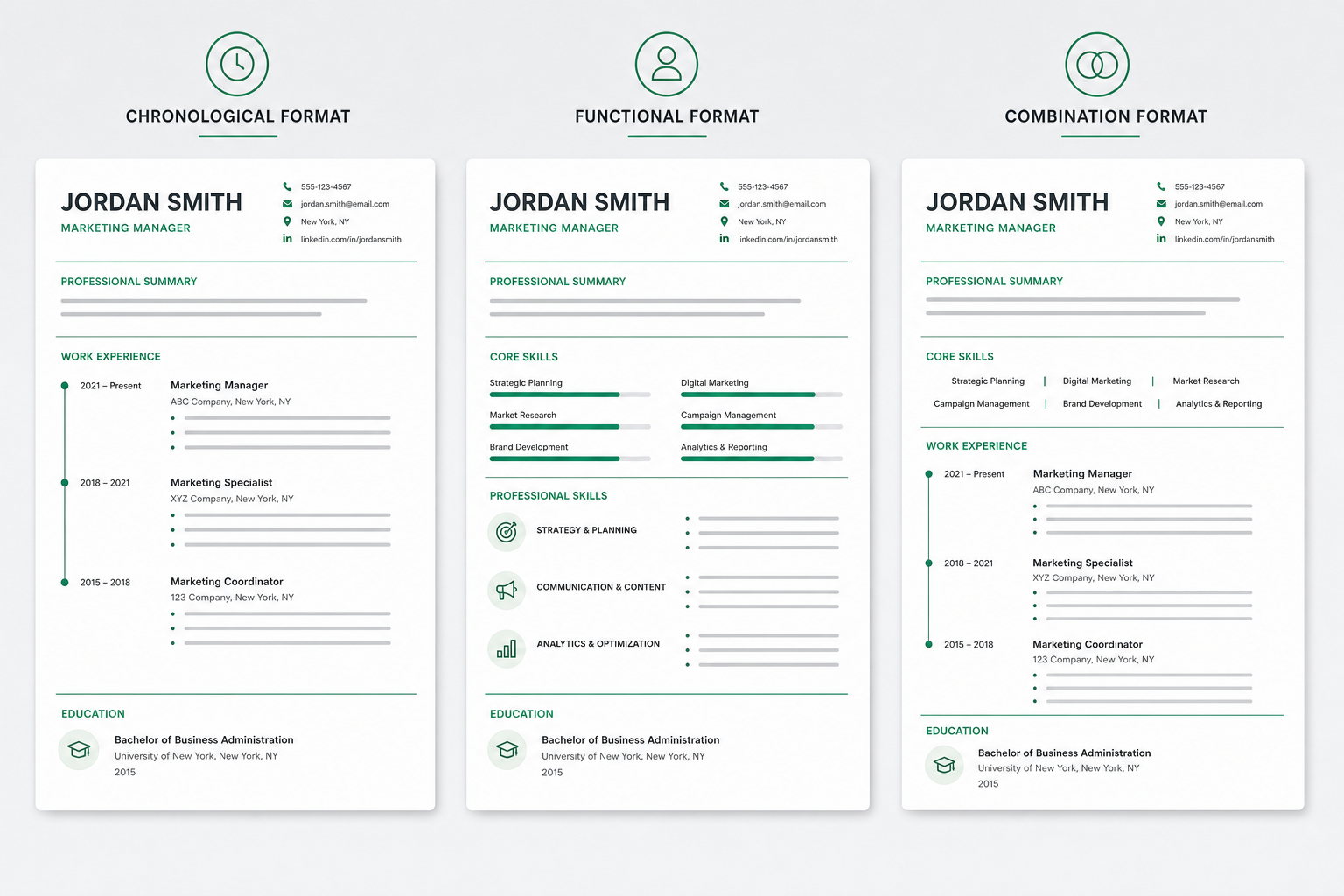
- Chronological. Best when your work history shows steady growth in one field.
- Functional. Emphasizes skills over timeline — useful for gaps or pivots when used carefully.
- Combination. Blends a skills summary with reverse-chronological experience for hybrid strength.
Choose the layout that puts your strongest proof where recruiters look first — usually the top third of page one.
Visual Elements That Boost Engagement
You do not need graphic-design flourishes to stand out. Professional clarity wins.
- Bold section headings that match conventional labels parsers expect.
- Ample white space so lines do not blur together on mobile screens.
- Readable fonts (11–12 pt body) such as Arial, Calibri, or Georgia — skip decorative type.
Resume Writing Strategies That Unlock Opportunities
- Lead with a concise summary tailored to the role, not a generic career objective.
- Stack proof early. Your most relevant role should appear near the top with your strongest bullets.
- Write with empathy. Mirror the employer’s priorities — speed, quality, compliance, growth — in how you describe your work.
Integrating Cover Letters for Maximum Effect
A cover letter should not repeat your resume line for line. Use it to connect one or two flagship wins to the company’s stated needs, show you researched the team, and explain why this role fits your trajectory. Keep tone confident and specific — one page is enough.
Why Customize for Each Job Today
Tailored resumes earn more interviews because they prove relevance before the first conversation. You demonstrate that you read the posting, understand the pain points, and invested effort in the application — signals hiring managers notice even when ATS scores are strong.
Real-Time Keyword Optimization in Practice
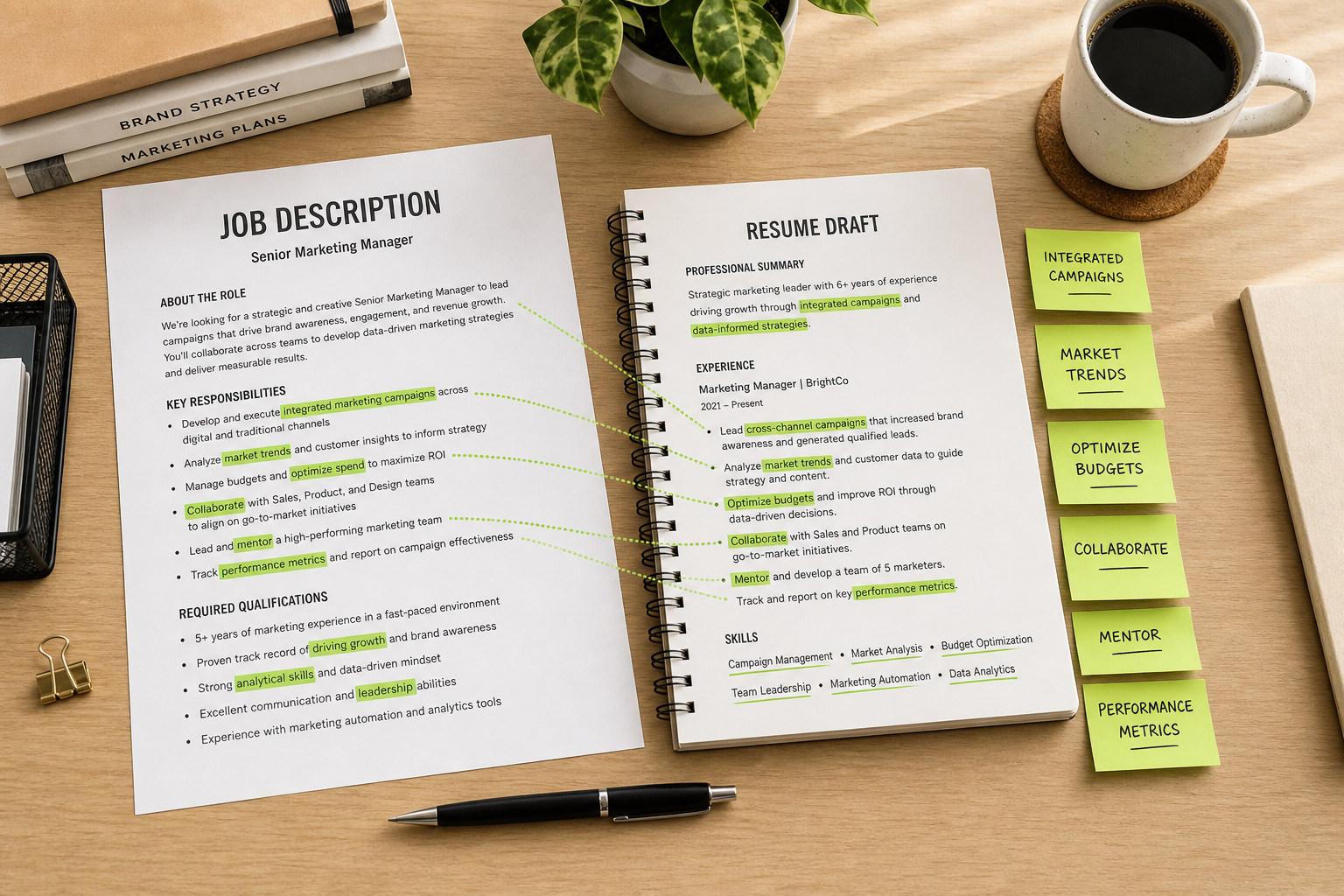
- Highlight repeated phrases in the job description — required skills, tools, certifications, soft skills.
- Map each phrase to a bullet or skills line where you have real evidence.
- Mirror company language from the careers page when it accurately describes your work.
- Re-run a quick pass with an AI assistant or checklist before you submit.
Conclusion
Standing out to employers in 2026 comes down to focus: tailor every resume, quantify impact, choose the right format, and use keywords naturally. AI can accelerate the tedious parts — scanning posts, spotting gaps, suggesting stronger verbs — but your judgment keeps the story honest.
Start customizing your next application today. Small, targeted edits compound into more callbacks, stronger interviews, and a clearer professional narrative.
Tailor Your Resume in Minutes
Try Shvii AI TodayFrequently Asked Questions
What is the importance of using industry-specific keywords in my resume?
Keywords help you pass ATS filters and signal relevance to recruiters. Match the language of the job post where it truthfully describes your skills — that improves both automated scoring and human scan speed.
How can I effectively quantify achievements on my resume?
Use concrete numbers: team size, revenue influenced, percentage improvements, deadlines beat, or hours saved. One specific metric per bullet is often enough to make the line memorable.
What are tips for formatting my resume to improve readability?
Use bold headings, bullet points, consistent spacing, and legible fonts. Keep margins generous and avoid tables or text boxes that parsers struggle to read.
How often should I update my resume if I am not actively job hunting?
Review every few months or after major projects, promotions, or new skills. A current resume saves panic when the right role appears unexpectedly.
What role do cover letters play in the job application process?
They add context — why this company, why this role, and which wins best predict your success. A strong letter complements a tailored resume instead of duplicating it.
How can I leverage AI tools to enhance my resume?
Feed in the job description and your draft, review keyword and phrasing suggestions, then edit for accuracy and tone. Use AI to iterate faster, not to invent experience.
What are common misconceptions about resume tailoring?
Tailoring does not always mean a full rewrite — often a adjusted summary and three to five bullet swaps are enough. It also helps early-career candidates who need to emphasize projects, internships, and transferable skills.
Keep going
Useful next steps from this article — tools to apply the advice, plus related career guides.
Tools
Related career guides
Account Executive Career Guide
Quota, attainment, and deal size. The sales resume is its own genre with its own rules.
Business Analyst Career Guide
The bridge role between business and engineering, and the bridge into both from elsewhere.
Customer Success Manager Career Guide
How to show impact when you do not carry a quota. The hardest resume problem in go to market.